One-Shot Lectures vs Full-Length Playlists: When Should You Use Which?
YouTube is packed with 10-hour 'One-Shot' marathons and 40-video deep-dive playlists. Choosing the wrong format at the wrong time can waste months of prep. Here is the definitive decision framework backed by cognitive science.
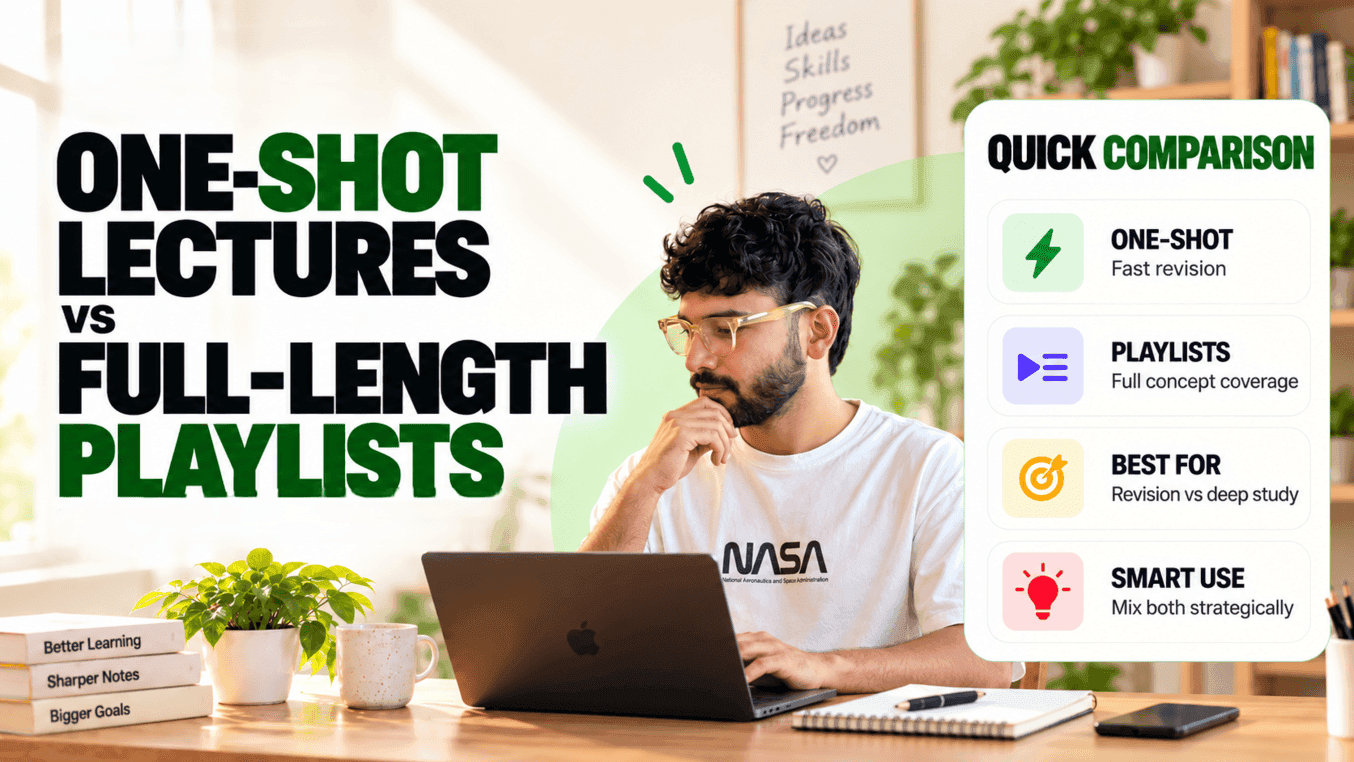
Key Takeaways
- One-shot lectures are built for revision, backlog clearing, and low-weightage chapters — NOT for first-time conceptual understanding.
- Full-length playlists are non-negotiable for foundation chapters (Calculus, Mechanics, Organic Reaction Mechanisms, Genetics) where step-by-step problem derivation is required.
- Beware of the "Fluency Illusion": watching a teacher solve problems for 8 hours without personal practice yields near-zero retention in actual mock tests.
- The Golden 1:2 Rule: for every 1 hour of video watched, dedicate 2 hours to active, closed-book PYQ problem solving.
- Whether you choose one-shots or playlists, using SyncStudy eliminates sidebar clickbait and tracks your syllabus completion automatically.
Turn Any YouTube Playlist or One-Shot Series into a Structured Course
Paste any playlist link into SyncStudy. Track your watch percentage, take timestamped notes, and study without sidebar recommendations or algorithmic rabbit holes.
Table of Contents
1. The Great YouTube Dilemma: Marathons vs Modular Playlists
If you search for any competitive exam topic on YouTube today — whether it is "Rotational Motion" for JEE, "Human Reproduction" for NEET, or "Geometry Triangles" for SSC CGL — you will instantly be confronted with two radically different video formats:
The Mega One-Shot (6 to 12 Hours)
A single monolithic video (PW Manzil, Unacademy BounceBack, Vedantu Marathon) claiming to teach the entire chapter from zero to hero in one continuous session.
Appeal: Instant dopamine. You feel you can conquer an entire month’s syllabus in a single weekend.The Full Modular Playlist (20 to 45 Videos)
A traditional coaching-style series (Mohit Tyagi, Physics Galaxy, Pradeep Kshetrapal) broken into 45-minute daily lectures with rigorous mathematical derivations and question variety.
Appeal: Complete conceptual depth. Zero skipped steps or rushed proofs.Students frequently treat this as a tribal debate: "Toppers only watch detailed playlists" vs "One-shots are the modern shortcut."
The truth is nuanced: Both formats are exceptional when deployed at the right point in your study cycle. Using the wrong format at the wrong time, however, is a catastrophic waste of hundreds of study hours.
2. Side-by-Side Comparison Matrix
Here is an objective benchmark comparing both formats across time commitment, cognitive load, problem solving, and long-term retention:
| Criteria | One-Shot Lectures (6–12 Hrs) | Full Modular Playlists (25–45 Hrs) |
|---|---|---|
| Primary Objective | Fast syllabus coverage & formula recapitulation | Deep intuition, derivations & graded problem tiers |
| Concept Depth | Direct formulas & standard case applications | First-principles logic, edge cases & historical nuances |
| Student Brain Fatigue | Extreme (burnout after hour 4) | Low (manageable 45-min bite-sized blocks) |
| Independent Solving Time | Teacher solves 85% of problems on screen | Homework assignments & step-by-step student practice |
| Best Stage in Prep | Backlogs, Revision (Month 8–12), Dropper Refresh | First-time study (Class 11 & 12 starting phase) |
| 30-Day Retention | 20% without rigorous note-taking & immediate PYQs | 70% due to spaced exposure across several weeks |
3. The 4 Rules: When to Watch One-Shot Lectures
One-shot marathons are potent tactical weapons when used under specific conditions. Here are the 4 scenarios where you should strictly choose a one-shot over a full playlist:
Rule 1: Urgent Backlog Recovery (Less Than 60 Days to Exam)
If your January attempt or NEET exam is 8 weeks away and you have 15 unfinished chapters, starting a 35-lecture playlist is mathematical suicide. You will run out of time before completing 3 chapters. Watch a high-yield 6-hour one-shot, extract the formula sheet, and spend the remaining 10 hours solving 5 years of PYQs.
Rule 2: Low-Weightage, Factual Chapters
Do not spend 25 hours studying chapters like Biomolecules, Polymers, Chemistry in Everyday Life, Mathematical Reasoning, or Surface Chemistry. These chapters test memory and direct factual recall, not 5-step algebraic intuition. A focused 3-to-4-hour one-shot gives you 100% of what is tested.
Rule 3: Comprehensive Pre-Mock Revision
If you already completed a chapter 3 months ago and are about to sit for a full-syllabus mock test, you do not need 30 hours of re-explanation. A 1.5x speed one-shot is the fastest way to reactivate dormant neural pathways and brush up on overlooked corner cases.
Rule 4: Dropper Concept Reactivation
Droppers who scored 85–95 percentile in their first attempt already understand basic definitions. Re-watching 12 months of classroom lectures causes boredom and passive drifting. Droppers should use one-shots to plug specific theory leaks, then spend 80% of their day in problem-solving trenches.
4. The 4 Rules: When You MUST Watch Full-Length Playlists
There are subjects and topics where taking a shortcut through a one-shot guarantees failure. Here are the 4 non-negotiable rules for when you must invest in modular playlists:
Rule 1: High-Weightage Core Foundation Pillars
Chapters like Mechanics (Rotational Motion & Kinematics), Calculus (Definite Integrals & Differential Equations), Organic Chemistry Mechanisms (GOC & Reaction Intermediates), and Genetics cannot be memorized. If your foundation here is shallow, you will fail 40% of the entire exam paper. These require 20+ dedicated lectures.
Rule 2: First-Time Exposure in Class 11 or Early Class 12
If you are seeing a topic for the very first time in your life, your brain needs cognitive incubation time between lectures. Watching a 10-hour one-shot produces immediate cognitive overload after hour 3. Modular playlists let you sleep on the material, process concepts overnight, and solidify memory.
Rule 3: Multi-Step Numerical Heavy Subjects (Physics & Physical Chemistry)
In physics and physical chemistry, exams test your ability to construct free-body diagrams and set up algebraic equations from unfamiliar word problems. In one-shots, the teacher does the hardest thinking for you. In a full series, you are exposed to 50+ graded problems across varying difficulty tiers.
Rule 4: Your "Weakest" Subject That You Historically Fear
If you have always struggled with Mathematics, a one-shot will feel like a firehose of confusing formulas. You need an educator who goes slowly, explains the "why" behind every step, and builds your confidence gradually lecture by lecture.
5. The Trap: The “Passive One-Shot Illusion”
Cognitive scientists call this the Fluency Illusion. When you watch an expert teacher on YouTube solve a complex electrostatics problem on a digital whiteboard, every single step feels logical and effortless.
- You sit for 8 hours with chips and tea, passively watching the video at 1.5x speed.
- You write down a few formulas but never pause the video to solve a problem before the teacher reveals the answer.
- You shut your laptop with a high feeling of achievement: “I just finished Ray Optics in one day!”
- Three days later in a mock test, a question presents an unfamiliar mirror combination. Your mind goes completely blank because you never built the neural circuitry to formulate the initial equation independently.
The Rule: Watching video lectures is passive recognition; answering exam questions is active retrieval. If your study time is 90% video watching and 10% problem solving, you will fail to convert your effort into percentile.
6. The 1:2 Rule: How to Balance Watching vs Solving
Regardless of whether you choose a one-shot or a full playlist, follow the 1:2 Ratio Protocol:
Watch lecture actively with timestamped note-taking.
Solve 25–40 PYQs with a timer. No video hints.
Log mistake types: concept gap vs silly calculation error.
7. Step-by-Step Decision Framework
Whenever you begin a new chapter on YouTube, answer these three quick questions to choose your format:
Have you studied this chapter at least once before?
• If YES → Choose One-Shot at 1.25x or 1.5x speed.
• If NO → Proceed to Question 2.
Does this chapter have high weightage (8+ marks in exam)?
• If YES → Choose Full-Length Playlist (don't cut corners).
• If NO → Proceed to Question 3.
Do you have more than 60 days before the exam?
• If YES → Choose Full-Length Playlist for complete mastery.
• If NO → Choose One-Shot to maximize marks within limited time.
8. How SyncStudy Turns Both Formats into a ₹1.5 Lakh Coaching LMS
Whether you are studying from a 10-hour One-Shot or a 40-video modular playlist, raw YouTube is hostile to serious learning:
- • YouTube loses your exact timestamp when switching between your laptop and phone.
- • Playlists lack a “Mark as Completed” checkbox, making it impossible to calculate your actual syllabus percentage.
- • The recommendation algorithm deliberately pushes viral entertainment and controversy videos directly into your feed.
SyncStudy: The Free LMS Built for YouTube Education
Paste any YouTube playlist or one-shot video link. Instantly generates a clean, ad-free course with chapter breakdowns.
Mark videos complete, view remaining watch hours, and track daily streaks across physics, chemistry, and maths.
Jot down formulas and definitions attached to exact video timestamps. Click any note to jump directly to that explanation.
Frequently Asked Questions
Are one-shot lectures alone enough to crack JEE Main 2027 or NEET?↓
For 70% of the syllabus, one-shots alone are NOT enough if you are learning a chapter for the first time. One-shots excel at rapid revision, clearing backlogs, or covering low-weightage factual chapters. However, core high-weightage chapters (like Rotational Motion, Mechanics, Integral Calculus, or Organic Mechanisms) demand multi-lecture playlists where the educator solves 40–60 graded practice problems step-by-step.
What is the "Passive One-Shot Illusion"?↓
The passive one-shot illusion happens when a student sits through an 8-hour marathon at 1.5x speed without pausing to solve questions independently. Because the teacher solves every problem effortlessly on screen, your brain tricks you into believing you understood the concept (fluency illusion). When you face an unfamiliar question in a mock test 3 days later, your score collapses.
What is the ideal ratio of video watching to self-practice?↓
The golden formula for competitive exams is the 1:2 rule. For every 1 hour of video lecture watched (whether one-shot or playlist), you must invest at least 2 hours solving Previous Year Questions (PYQs) and mock questions independently without looking at hints or solutions.
How do I organize and track a 30-video playlist without getting distracted on YouTube?↓
Standard YouTube is engineered for entertainment, bombarding you with recommended shorts and comments. You can copy any playlist URL and paste it into SyncStudy (syncstudy.in). It instantly turns the playlist into a private, distraction-free course with chapter-by-chapter progress tracking, timestamped notes, and completion analytics.
Can droppers rely on one-shots for their entire syllabus?↓
Droppers who already understood the fundamental theory during Class 11 and 12 can use quality one-shots (like PW Manzil or Unacademy BounceBack) to quickly reactivate their concepts, spending 80% of their remaining time solving PYQs and taking full-length mock tests.
Related Student Guides
How to Finish a YouTube Playlist Faster
Proven techniques to complete educational playlists 3x faster without losing retention.
7 Best Free Tools to Learn from YouTube
Top apps and extensions to convert YouTube into a structured study environment.
10 Science-Backed Study Techniques
Active recall, spaced repetition, and the Feynman technique applied to exam prep.