10 Science-Backed Study Techniques for Competitive Exams: Complete Guide for JEE, NEET & Board Aspirants
Discover the most effective study techniques proven by cognitive science. From active recall to spaced repetition — learn how to study smarter, retain more, and ace your competitive exams without burning out.
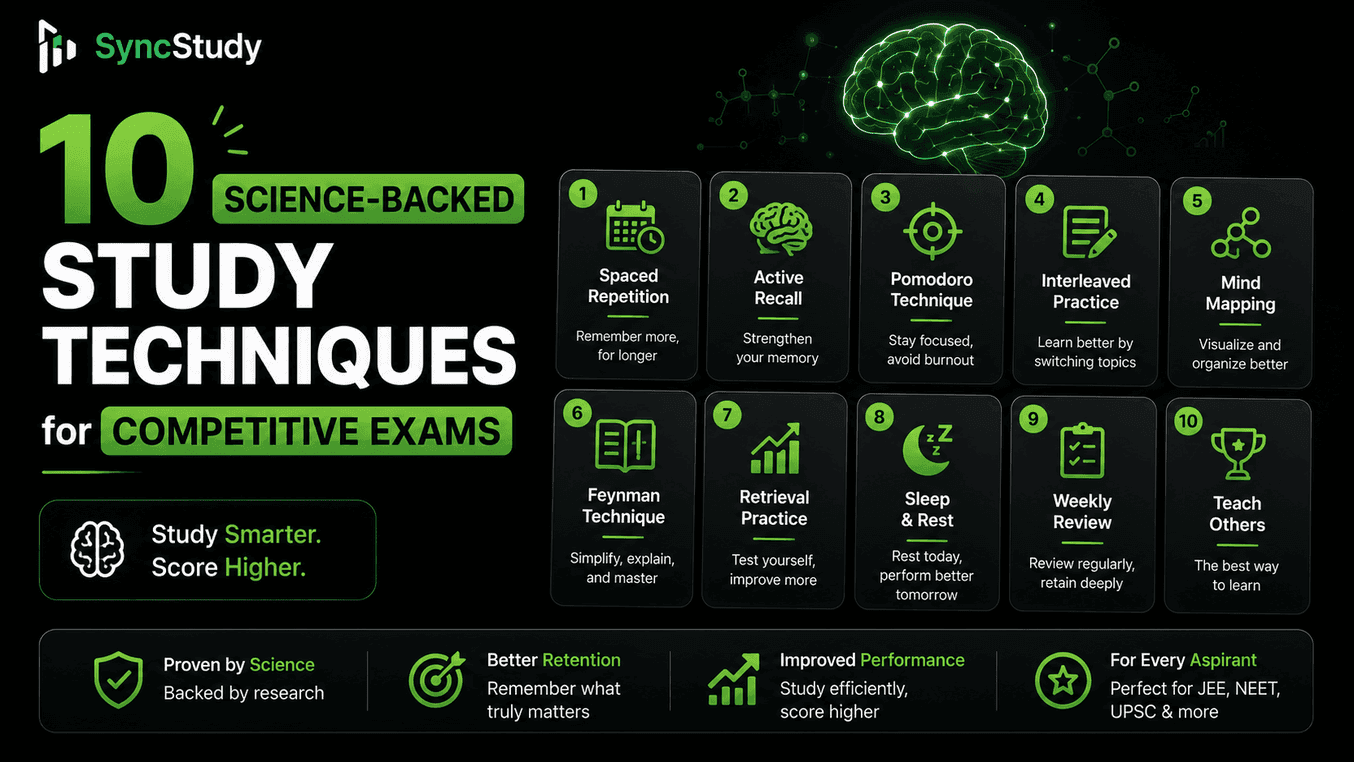
Key takeaways
- Active recall is the single most effective study technique — 50% more effective than re-reading notes
- Spaced repetition combats the forgetting curve and improves long-term retention by 40-60%
- Combining multiple techniques like Feynman, interleaving, and practice testing yields the best results
- Structured YouTube learning with progress tracking boosts course completion rates by 3x
- Consistent daily practice of 2-3 hours beats marathon 10-hour sessions for retention
🚀 Master These Techniques with Structured Learning - Free
Use SyncStudy's free YouTube to course converter to apply these techniques with any playlist.
Table of Contents
Why Study Techniques Matter for Competitive Exams
🎥 Watch: How to Study Effectively Using Science-Backed Techniques
📹 Visual walkthrough of the techniques discussed below — perfect companion to this guide.
Over 25 lakh students appear for JEE Main every year. Fewer than 2 lakh qualify for JEE Advanced. For NEET, the numbers are even starker — 20+ lakh aspirants competing for ~1 lakh MBBS seats. The difference between success and failure often isn't intelligence — it's how you study.
Research from the Association for Psychological Science and UCLA's Bjork Learning Lab shows that students who use evidence-based study techniques outperform those who rely on passive methods like re-reading and highlighting — by as much as 50% in retention tests.
Yet the vast majority of Indian students still spend hours re-reading textbooks, copying notes verbatim, and watching YouTube videos passively. This guide will show you exactly which techniques work, why they work, and how to implement them using free tools — including YouTube and SyncStudy.
📊 The Cost of Ineffective Studying:
- • Students who use active recall score 1.5 to 2 letter grades higher on exams (Karpicke & Roediger, 2008)
- • Spaced repetition improves long-term retention by 40-60% compared to massed practice
- • Interleaving practice boosts problem-solving accuracy by 43% over blocked practice
- • The average Indian student loses 60% of learned content within 24 hours without review
🇮🇳 The Indian Competitive Exam Reality:
- • JEE Main 2025: ~25 lakh applicants, ~2.5 lakh qualify for Advanced
- • NEET UG 2025: ~24 lakh applicants, ~1.1 lakh MBBS seats
- • UPSC Prelims 2025: ~13 lakh applicants, ~15,000 qualify for Mains
- • Less than 5% of aspirants use any structured study technique systematically
Understanding How Your Brain Learns: The Science of Memory
Before diving into specific techniques, it helps to understand the three fundamental processes your brain uses to learn and retain information.
Encoding
The process of converting new information into neural codes. Deep encoding happens when you connect new information to existing knowledge — not when you passively read or highlight.
Consolidation
The brain stabilizes memories during sleep and rest. This is why cramming doesn't work — your brain needs time to transfer information from short-term to long-term memory.
Retrieval
Each time you recall a memory, it becomes stronger and more accessible. This is the foundation of active recall — the single most powerful learning technique known to science.
📈 The Ebbinghaus Forgetting Curve
In 1885, German psychologist Hermann Ebbinghaus discovered that we forget information at an alarming rate — losing 70% of new content within 24 hours unless we actively review it. However, strategic review at increasing intervals (spaced repetition) flattens this curve dramatically.
❌ Without Spaced Review:
- • 1 hour: Retain ~44%
- • 24 hours: Retain ~30%
- • 1 week: Retain ~15%
- • 1 month: Retain ~5%
✅ With Spaced Review:
- • 1 hour: Retain ~85%
- • 24 hours: Retain ~70%
- • 1 week: Retain ~55%
- • 1 month: Retain ~45%
Active Recall: The Single Most Effective Study Technique
What Is Active Recall?
Active recall is the practice of actively retrieving information from memory rather than passively reviewing it. Instead of re-reading your textbook, you close it and try to write down everything you remember. This simple shift — from passive to active — is the single most impactful change you can make to your study routine.
How to Practice Active Recall
Study a Topic Once
Read or watch a video with full attention — no distractions, no multitasking
Close Everything
Close your book, notes, or video. The harder it feels, the more it works
Write What You Remember
On a blank page, write everything you can recall — in your own words, in any order
Check and Fill Gaps
Open your source material and compare. What did you miss? Focus your next session there
Repeat for Weak Spots
Only re-study the portions you forgot — don't waste time on what you already know
🔬 What Research Says:
In a landmark 2008 study by Karpicke and Roediger at Purdue University, students who used active recall remembered about 80% of material after one week, compared to only 30% for students who simply re-read the material. The study concluded that "retrieval practice is a powerful mnemonic enhancer, often producing better retention than repeated study."
Want ready-to-use active recall prompts? See our 25 ChatGPT Prompts for JEE, NEET & UPSC Students — copy-paste prompts that force retrieval, not recognition.
Spaced Repetition: Stop Forgetting What You Study
What Is Spaced Repetition?
Spaced repetition is the practice of reviewing material at gradually increasing intervals over time. Instead of re-reading a chapter every day, you review it after 1 day, then 3 days, then 7 days, then 14 days, and so on. Each review arrives just as your brain is about to forget — forcing it to work harder and strengthening the memory.
Your Spaced Repetition Schedule
Free tools like Anki automate this entire process for you. Its algorithm tracks which cards you struggle with and shows them more frequently, while hiding cards you've mastered. For Indian students preparing for JEE, NEET, or UPSC, this is revolutionary — you can maintain thousands of flashcards with minimal daily effort.
🎯 Pro Tip for Indian Students:
Create digital flashcards for every chapter you study. Use Anki's mobile app to review during your commute, while waiting in lines, or during meal breaks. Even 10 minutes of spaced repetition daily compounds into massive long-term gains.
The Feynman Technique: Master Any Complex Topic
What Is the Feynman Technique?
Named after Nobel Prize-winning physicist Richard Feynman, this technique involves explaining a concept in the simplest possible language — as if teaching it to a child or someone with no background in the subject. If you can't explain it simply, you don't understand it well enough.
1. Choose a Topic
Pick a concept you're studying — say, Newton's Laws of Motion or Organic Reaction Mechanisms
2. Teach It Simply
Write an explanation using plain language. Avoid jargon. Use analogies. Imagine explaining to a younger sibling
3. Find the Gaps
Where did your explanation break down? Where were you vague? Those are your knowledge gaps — mark them
4. Review and Simplify
Go back to your source material for the gaps. Re-explain. Repeat until your explanation is clear and simple
🧪 Why This Works for Competitive Exams:
JEE and NEET questions rarely test rote memorization — they test conceptual understanding. The Feynman Technique forces you to build deep mental models. Students who regularly practice it consistently score higher in numerical and application-based questions.
Interleaving: Mix Subjects for Stronger Understanding
What Is Interleaving?
Interleaving means mixing different topics or subjects within a single study session instead of mastering one topic completely before moving to the next. Most students study in "blocks" — 2 hours of Physics, then 2 hours of Chemistry. Research shows the opposite approach is far more effective.
❌ Blocked vs ✅ Interleaved Practice
Traditional Blocked Study
- • 2 hours: Physics - Kinematics
- • 2 hours: Chemistry - Thermodynamics
- • 2 hours: Maths - Calculus
- Problem: Your brain knows what topic to expect. It doesn't learn to discriminate.
Interleaved Study
- • 40 min: Physics - Kinematics problems
- • 40 min: Chemistry - Thermodynamics MCQs
- • 40 min: Maths - Calculus integrals
- Benefit: Your brain must identify the problem type first — exactly like in exams.
A landmark study from UCLA (Rohrer & Taylor, 2007) found that students who used interleaving scored 43% higher on a surprise test than those who used blocked practice. The effect was even more pronounced a week later — interleavers retained significantly more. For JEE and NEET, where questions from mixed topics appear randomly, this technique directly mirrors exam conditions.
Pomodoro for Exam Prep: Maintain Peak Focus
Pomodoro Technique for Indian Students
The Pomodoro Technique uses timed focus intervals (typically 25 minutes) separated by short breaks (5 minutes). After four intervals, take a longer 15-30 minute break. For competitive exam prep, we recommend customizing the intervals to match your attention span and subject difficulty.
Customized Pomodoro for JEE/NEET Prep
🔄 Sample Study Session Using Pomodoro:
Session 1 (Morning):
- • 6:00-6:30 — Physics (Active Recall + Feynman)
- • 6:30-6:35 — Break
- • 6:35-7:05 — Chemistry (Spaced Repetition + Flashcards)
- • 7:05-7:10 — Break
- • 7:10-7:40 — Maths (Practice Problems)
- • 7:40-8:10 — Long Break
Session 2 (Evening):
- • 5:00-5:25 — Review morning weak spots
- • 5:25-5:30 — Break
- • 5:30-6:00 — Solve PYQs (interleaved topics)
- • 6:00-6:05 — Break
- • 6:05-6:35 — Active recall of key formulas
- • 6:35-7:00 — Weekly progress review
Cornell Note-Taking System for Video Lectures
Cornell Method Adapted for YouTube Learning
The Cornell Note-Taking System divides your page into three sections: a narrow cue column on the left, a larger notes column on the right, and a summary section at the bottom. This structure is ideal for YouTube lectures — you can take timestamped notes in the main area, write keywords and questions in the cue column, and summarize key takeaways.
📝 Cornell Note Template for Video Learning
Cue Column (Keywords & Questions)
Notes Column (Timestamped)
Summary
Active recall is the #1 study technique. Close your book and force retrieval. Review Karpicke study for evidence. Implement in every study session using the 5-step method.
For YouTube learning, this system works exceptionally well. Use SyncStudy's built-in timestamped notes feature to create Cornell-style notes directly alongside your video progress. Each note is automatically linked to the exact video moment, making review sessions incredibly efficient.
Practice Testing: The Ultimate Performance Booster
Why Practice Testing Works
Practice testing — taking practice exams or quizzes on material you've studied — is one of the most effective learning techniques. It combines active recall with the benefits of exam simulation. Every JEE and NEET topper will tell you: the more practice tests you take, the better you perform.
📊 Benefits of Practice Testing
- Identifies knowledge gaps you didn't know existed
- Reduces exam anxiety through familiarization
- Improves time management and speed
- Strengthens memory retrieval pathways
- Builds confidence through measurable progress
🎯 How to Use It Effectively
- Take a practice test BEFORE studying — see what you know
- After each chapter, create 5-10 self-test questions
- Use PYQs (Previous Year Questions) as your primary test bank
- Analyze wrong answers — they teach you more than correct ones
- Simulate exam conditions: timed, no distractions, no pauses
🔬 Research Evidence:
A comprehensive meta-analysis by Adesope et al. (2017) examined over 200 studies on practice testing and found it to be one of the most effective learning strategies across all age groups and subjects. Students who regularly self-tested outperformed those who only studied by an average of one full letter grade.
How to Combine These Techniques with YouTube Learning
YouTube is the most powerful free learning resource for Indian students — but only when used correctly. Here's how to apply the techniques above to your YouTube study sessions.
🔄 YouTube Study System: Before vs After
❌ Passive Watching (Ineffective)
- • Watch video from start to end without pausing
- • No notes taken during the lecture
- • Move to next video immediately
- • Never review what was learned
- • No practice or self-testing
✅ Active YouTube Learning (Effective)
- • Pause every 5-7 minutes for active recall
- • Take timestamped Cornell-style notes
- • Practice Feynman technique after each video
- • Schedule review at spaced intervals
- • Solve problems related to video content
🚀 SyncStudy Makes This Effortless:
- • Auto-generate syllabus from any playlist
- • Track video completion
- • Set learning milestones
- • Timestamped notes per video
- • AI-powered summaries
- • Export for spaced repetition
- • Study streak tracking
- • Time spent per topic
- • Practice quiz integration
Step-by-Step: YouTube Active Learning Routine
Set Up Your Course
Paste your YouTube playlist URL into SyncStudy to create a structured course with a syllabus and milestones
Preview the Video
Read the title and description. Set 2-3 learning goals for what you want to understand by the end
Watch with Active Recall
Watch in focused intervals. Pause after key segments and mentally summarize what you just learned
Take Timestamped Notes
Use SyncStudy's note feature to capture key points at specific timestamps for easy review later
Apply Feynman Technique
After the video ends, explain the concept out loud or in writing as if teaching a classmate
Schedule Spaced Review
Set reminders to review your notes after 1 day, 3 days, and 7 days using SyncStudy's scheduler
Top Tools to Implement Your Study System
You don't need expensive coaching or apps. These free tools will help you implement every technique discussed in this guide.
Must-Have Free Tools
- SyncStudy — Turn YouTube playlists into structured courses
- Anki — Automated spaced repetition flashcards
- Notion — Organize study notes and track progress
- Forest — Stay focused with gamified Pomodoro
- Google Calendar — Schedule your study blocks
How to Combine Them
- SyncStudy manages your course & progress tracking
- Anki manages your spaced repetition review system
- Notion stores your Cornell notes and study plans
- Forest keeps you accountable during study sessions
- Calendar organizes your weekly schedule
Common Study Mistakes That Waste Your Time
🚫 These Habits Are Costing You Marks
Real Success Stories from Indian Students
"I was stuck in a cycle of passive studying — watching hours of YouTube lectures but forgetting everything a week later. Active recall and spaced repetition changed everything. I used SyncStudy to structure my YouTube playlists into proper courses and Anki for flashcards. My retention went from barely 20% to over 70%."
"The Feynman Technique was my game-changer. After watching each biology video on SyncStudy, I'd explain the concept to my younger sister. If she didn't understand, I knew I had gaps. My practice test scores improved by 40% in just two months."
"Interleaving and Pomodoro together completely transformed my board exam preparation. I stopped doing marathon 6-hour sessions and switched to focused 35-minute blocks with mixed subjects. I was studying less but learning more. SyncStudy helped me track which topics I had reviewed and which needed attention."
📈 The Common Thread:
Every successful student mentioned above combined evidence-based study techniques with structured learning tools. They didn't study more hours — they studied more effectively. SyncStudy provided the structure to track progress and apply techniques consistently.
Your 30-Day Study Transformation Plan
🚀 4 Weeks to Master Any Subject
- Track your current study methods
- Set up SyncStudy and Anki
- Learn active recall technique
- Create study space without distractions
- Practice active recall daily
- Start spaced repetition cycles
- Implement Pomodoro sessions
- Take Cornell notes for every video
- Apply Feynman Technique
- Start interleaving subjects
- Take weekly practice tests
- Review and refine your system
- Full mock tests under time pressure
- Analyze weak areas systematically
- Optimize your study schedule
- Plan long-term review strategy
💡 Pro Tip: After 30 days, these techniques will be habits. You'll study less time but retain more. Your practice test scores will improve without additional effort — just smarter methods.
Share This Guide
Help other students discover science-backed study techniques. Share this comprehensive guide with friends preparing for competitive exams.