YouTube Playlist to Notes — How to Turn Any Playlist Into Notes
Turn any YouTube playlist into structured timestamped notes, real-time progress tracking, and an automated daily study plan. Learn the exact 3-step system to finish video courses 3x faster without forgetting concepts.
Key takeaways
- Passive video binge-watching causes an 80% memory drop within 48 hours unless notes are actively encoded with clickable timestamps.
- The 3-Pass Video Learning Framework (Macro Flow → Timestamp Extraction → Active Recall Test) prevents split-attention cognitive overload.
- The 3-Column Video Cornell Method anchors every formula, rule, or code bug directly to an exact video timestamp.
- Calculate realistic course completion using the 1.5x buffer formula: (Raw Duration ÷ Playback Speed) × 1.5.
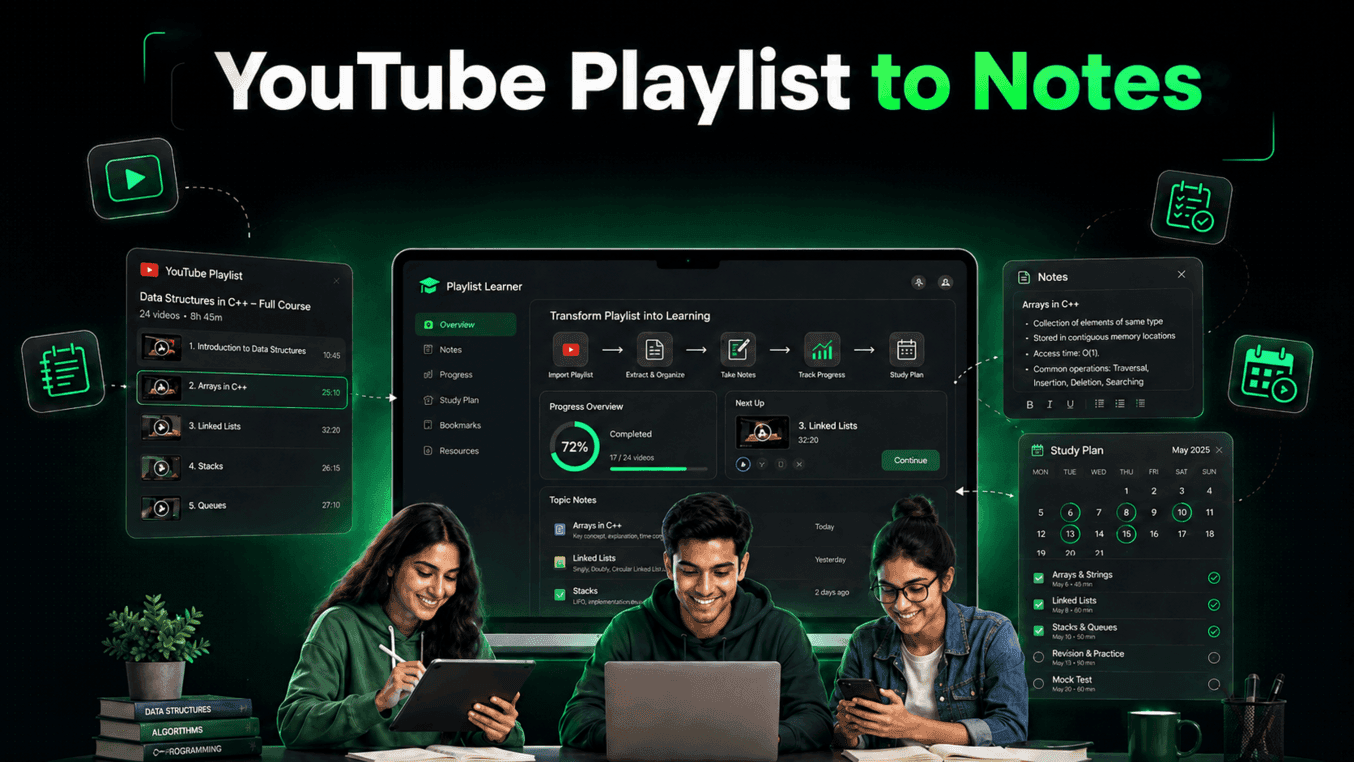
- SyncStudy converts any YouTube playlist into an interactive course with per-video notes, progress bars, and calendar scheduling for free.
Turn Your YouTube Playlist Into a Course Free
Paste any YouTube playlist link into SyncStudy and get a clean distraction-free player, timestamped notes, progress tracking, and an automated study plan.
Table of Contents
The Neuroscience of Video Learning: Overcoming the "Illusion of Competence"
YouTube is the world's greatest free university, but 87% of students never finish a multi-video playlist.
When you watch an expert instructor fluently solve a problem, your brain experiences the Fluency Heuristic. It feels intuitive, so you nod along without taking structured notes. But 48 hours later, your working memory has retained less than 20% of that knowledge.
Passive Watchers vs 1% Power Learners
- • Binge 4-5 videos in a row without pausing
- • Transcribe word-for-word on scrap paper
- • Zero timestamps; impossible to revise formulas
- • Lose course progress and abandon playlist
- • Capture 3–5 atomic concept anchors per lecture
- • Embed clickable timestamps (
[08:14]) - • Run a 5-minute active recall self-test
- • Track real completion percentage on a calendar
The 3-Pass Video Mastery System for Deep Retention
Trying to write comprehensive notes while listening causes the Split-Attention Effect. Instead, use this 3-Pass Framework:
PASS 1Macro Conceptual Flow (1.25x Speed, Zero Pauses)
70% video lengthWatch straight through without stopping to write long notes. Build a macro mental map: what problem is being solved, and what are the 3 major pillars of the lecture?
PASS 2Atomic Timestamped Extraction (Targeted Pauses)
20% video lengthJump directly to the critical timestamps (derivations, code syntax, architectural models). Capture formulas and code snippets into your SyncStudy notes with clickable anchors like [12:45].
PASS 3Active Recall Stress-Test (5-Minute Screen-Closed Test)
5 mins post-videoClose the video. Answer 2 self-test questions from memory. If you cannot answer immediately, click the timestamp in your note to re-watch only that 30-second snippet.
The 3-Column Video Cornell Note-Taking System
Tailored specifically for modern video courses, the 3-Column Video Note Architecture gives you instant retrieval:
Anchors your note to the exact second in the lecture.
1–2 sentence rule explaining why and how it works.
Active recall prompt to test yourself during revision.
Concrete Comparison: Bad Transcription vs High-Yield Video Note
"The teacher said that when we do rotational physics we have to be careful about torque because torque is like force for rotation. Then he wrote formula on board and solved 3 questions on rod. Remember torque = r x F."
τ = r × F = r·F·sin(θ). Direction via right-hand rule.
For rod mass M length L about hinge: I = (1/3)ML². Weight at L/2!
How to Calculate True Playlist Study Velocity & Deadlines
Example: A 30-hour Web Development playlist watched at 1.25x speed:(30 hrs ÷ 1.25) × 1.5 = 36 Actual Study Hours.
At 1.5 hours per day, you will complete the full course in exactly 24 calendar days.
4 Methods to Turn YouTube Playlists into Notes Compared
| Method | Timestamp Links | Progress Checkmarks | Study Velocity | Verdict |
|---|---|---|---|---|
| SyncStudy | Automatic (Alt + T) | Built-in Per Lecture | Automated Calendar | 🏆 Best Overall |
| Notion / Obsidian | Manual Copy-Paste | Manual Table Setup | Manual Formulas | High setup friction |
| Pen & Paper | None (Static) | Manual Checkmarks | Manual Calculation | No search / video jump |
| Chrome Extensions | Yes | No Playlist Overview | None | Fragile & lacks plan |
Step-by-Step: Converting Any Playlist with SyncStudy
Copy Your Target Playlist URL
Find your course playlist on YouTube and copy the browser URL.
Paste into SyncStudy Course Converter
Paste the link into SyncStudy. It automatically builds chapter breakdowns, calculates total watch duration, and opens a clean distraction-free player.
Take Notes with Instant Timestamps (Alt + T)
Write notes side-by-side. Press Alt + T to instantly drop a clickable timestamp anchor into your notes.
Track Milestones & Export Your Notebook
Tick off completed lectures, maintain your streak, and export your consolidated notebook to Markdown or PDF.
Domain Blueprints: Coders, JEE/NEET, UPSC & College Students
Software Developers & Bootcamps
Timestamp bug fixes, CLI setup commands, and architectural logic. Link your GitHub commit SHA right beneath the lecture timestamp.
JEE & NEET Exam Aspirants
Convert 90-video chapter series (Physics Wallah, Mohit Tyagi) into high-yield formula sheets with timestamped numerical steps.
UPSC & State PSC Aspirants
Synthesize history and polity playlists into 3-point bullet notes, tagging constitutional articles to video moments.
Semester Exam Crammers
Use the 5-2 velocity formula to compress a 4-month university syllabus into 10 days of daily quotas with active recall flashcards.
Copy-Paste Active Recall & AI Revision Prompt
"I have finished a lecture on [Topic Name] from my YouTube playlist. Here are my timestamped notes:
[Paste your SyncStudy notes here]

Please generate:
1. Three tricky conceptual questions that test edge cases (not simple definitions).
2. One scenario-based problem requiring calculation or implementation.
3. Identify any common exam or interview traps related to these notes."
Frequently Asked Questions
How do I turn a YouTube playlist into structured notes for free?
Use SyncStudy (syncstudy.in). Simply copy and paste your YouTube playlist link into the platform. It automatically organizes the entire playlist into a distraction-free course view with a split-screen notes editor. You can drop clickable timestamps with a single shortcut (Alt + T), write formulas or code, and export your consolidated notebook to Markdown or PDF.
Why do most students forget 80% of YouTube lectures within 48 hours?
This cognitive trap is known as the 'Illusion of Competence' (or Fluency Heuristic). Because expert teachers make explanations look seamless, our brain mistakes passive viewing for understanding. Without active retrieval, timestamped anchoring, and spaced recall, the brain purges up to 80% of video concepts within 48 hours (Ebbinghaus Forgetting Curve).
How does the 3-Pass Video Learning system work?
Pass 1 (Macro Flow, 1.25x speed): Watch straight through without pausing to build a high-level conceptual map. Pass 2 (Atomic Extraction): Pause only at crucial moments to capture derivations, formulas, or code snippets anchored by clickable timestamps. Pass 3 (Active Recall Test): Close the screen for 5 minutes and answer 2 self-test questions from memory.
How do I calculate the actual time needed to finish a YouTube playlist?
Use the Real Study Velocity formula: Actual Study Time = (Raw Playlist Duration ÷ Playback Speed) × 1.5. The 1.5x buffer accounts for pausing, code execution, derivations, and note-taking. A 30-hour playlist at 1.25x speed requires 36 actual study hours. At 1.5 hours per day, you will finish it in exactly 24 calendar days.
Why are timestamped notes better than ordinary notes for competitive exams and coding?
When revising complex topics months later, reading a brief summary might still leave you confused about a subtle derivation step or bug fix. Clicking on an embedded timestamp (e.g. [14:22]) instantly opens the lecture at the exact second the educator explains that specific concept, eliminating hours of searching through video archives.
Is SyncStudy completely free to convert YouTube playlists to courses?
Yes! SyncStudy offers a generous 100% free plan that lets you convert YouTube playlists into complete trackable courses with per-video timestamped notes, progress percentage tracking, and an automated study planner with no credit card required.
Final Verdict: Mastering YouTube Learning
YouTube learning works when you treat playlists like real university courses. The difference between students who abandon playlists and those who master subjects is having a system for timestamped notes, progress tracking, and scheduled deadlines.
With SyncStudy, you can convert any YouTube playlist into an interactive course with per-video notes, progress bars, and calendar schedules in under 30 seconds for free.
Convert YouTube Playlist FreeRelated Student Guides
How to Finish a YouTube Playlist Faster
Proven strategies to complete playlists 3x faster with scheduling and focus.
Free YouTube Playlist Tracker for Students
Mark videos done, track completion %, and never lose your place again.
Best Free Tool to Learn from YouTube
Turn any playlist into a structured course with notes & planner.