Winter Arc 2026: Meaning, Rules, 90-Day Challenge & How to Start
Everyone waits for January 1 to change their life. The Winter Arc asks a different question: what if you started three months earlier?
It is October 1, 2026. There are roughly three months left in the year. While most people spend the final quarter mentally checking out, scrolling holiday feeds, and postponing their ambitions for a vague New Year resolution, the Winter Arc 2026 is about doing the exact opposite. It is a dedicated 90-day window to build quiet, sustainable momentum in studying, fitness, sleep, reading, learning a high-value skill, reducing screen time, and fixing messy daily routines.
Despite what you might have seen on social media, the Winter Arc is not just a gym challenge, and it does not require you to wake up at 4:30 AM to take freezing cold showers. It is simply an intentional framework to make the last quarter of the year your most productive one. Here is everything you need to know about the meaning, dates, rules, routines, and realistic strategies to execute your own Winter Arc successfully.
Key takeaways
- The Winter Arc is a self-improvement period running from October 1 to December 31, designed to build daily habits before the new year arrives.
- There is no universal official rulebook: the best routine consists of 3 to 5 realistic daily non-negotiables tailored to your life.
- Winter Arc applies to studying, coding, reading, and mental wellness just as much as fitness and physical training.
- Avoid influencer extremes like 4:30 AM wake-ups or 15 complicated rules; sustainable daily execution beats burnout every time.
- If you miss a day, do not restart from Day 1. Diagnose the friction, fix your environment, and resume the next morning.
Table of Contents
What is the Winter Arc?
The phrase gained massive momentum across social platforms as people began sharing aesthetic checklists, study routines, and workout transformations under the winter theme. As daylight hours shorten and the weather cools down in the Northern Hemisphere, social gatherings naturally shift, and people find themselves spending more time indoors. The Winter Arc takes advantage of this seasonal shift by treating the final quarter of the year as a structured personal sprint.
It is important to clarify that there is no central authority, governing body, or official trademark behind the concept. Different online communities adapt the framework to their own priorities: fitness creators emphasize strength training and clean eating, programmers focus on shipping projects and solving coding problems, and students use it to complete exam syllabi before finals arrive. At its core, the Winter Arc is simply an agreed-upon timeline for deliberate self-discipline.
When does Winter Arc 2026 start and end?
The standard timeline for Winter Arc 2026 is clear:
October 1, 2026
The beginning of the fourth calendar quarter.
December 31, 2026
New Year's Eve midnight checkpoint.
Some people choose to extend their challenge into mid-January or align their start date with local holidays. However, having a defined beginning (October 1) and an immovable finish line (December 31) gives the sprint psychological urgency. When you know there are fewer than 100 days remaining before the year closes, every single week carries real weight.
Why is everyone doing a Winter Arc?
The appeal of the Winter Arc is rooted in practical human psychology rather than internet hype. There are five main reasons why millions of students and young professionals take part every autumn:
1. It gives the final quarter of the year a real purpose
Between festival seasons, holidays, and chilly weather, it is extraordinarily easy to slip into auto-pilot around October and write off the remainder of the year. The Winter Arc replaces mental drift with an active mission.
2. It creates a concrete, visible deadline
Open-ended goals like "I want to get fit" or "I need to study more" usually dissolve because there is no countdown. December 31 provides a strict finish line where you can measure exactly what you achieved.
3. It turns vague self-improvement into daily measurable actions
Instead of telling yourself "I will be more productive," the Winter Arc forces you to define binary rules: "I will do one 90-minute focused study block every weekday" or "I will log a 30-minute walk daily."
4. It flips the flawed New Year's resolution model
Most New Year's resolutions collapse by January 15 because people try to go from zero to one hundred overnight in the middle of winter. With a Winter Arc, you arrive at January 1 having already practiced your target habits for three straight months.
5. Social accountability makes consistency engaging
Watching peers share checklists, habit trackers, and milestone updates makes discipline feel shared rather than lonely. However, you do not need to post online to benefit from the challenge—quiet, private tracking works just as effectively.
Winter Arc rules: what should you actually do?
There are no official Winter Arc rules. The best version of the challenge is the one simple enough that you will still be following it on a freezing Tuesday in mid-December.
The most common mistake beginners make is writing down twelve extreme rules on Day 1—waking up at 4:30 AM, reading 50 pages, running 10 kilometers, quitting all sugar, and studying 10 hours daily. By Day 6, exhaustion sets in, they miss a rule, feel guilty, and abandon the entire challenge.
A much more reliable approach is choosing 3 to 5 core rules that target the high-leverage areas of your daily life:
Commit to 60 to 120 minutes of uninterrupted, phone-free work on your primary priority every single day. This could be studying, coding a project, writing, or learning a specific skill.
Keep movement flexible: going to the gym 4 times a week, a brisk 45-minute daily walk, running, yoga, or home calisthenics. The goal is regular physical activity, not extreme fatigue.
Maintain a consistent bedtime and wake-up window that gives you 7 to 8 hours of sleep. The Winter Arc does not require 4:00 AM wake-ups. Sleep deprivation destroys cognitive focus and habit consistency.
Identify your single biggest digital leak (Instagram Reels, YouTube Shorts, mobile gaming, doomscrolling) and set a hard boundary, such as no scrolling before noon or a 45-minute daily cap.
Use a simple physical wall calendar, a paper journal, or a dedicated tracking tool. When you mark an "X" or log completed tasks each night, you remove ambiguity about whether you showed up.
The best Winter Arc rules for students
For students in school, college, or preparing for entrance exams, the Winter Arc is a critical academic window. However, many students set counterproductive rules like "study 10 hours every day."
Vague time goals invite procrastination: you sit in front of an open book for 8 hours while daydreaming or replying to messages, and you end the day exhausted without having finished a single chapter.
Instead, structure your student Winter Arc around concrete outputs and clear boundaries:
A Realistic Student Winter Arc Framework:
- Complete 1 meaningful daily output: For example, finish 2 targeted lecture videos and solve 30 numerical problems, or complete 1 textbook chapter and write concise summary notes.
- Cap entertainment screen time: Keep non-study social media below 60 minutes per day and keep your phone in another room during study blocks.
- Physical reset: Take a 30-minute walk or workout 4 to 5 days a week to clear mental fog.
- Sleep anchor: Be in bed by 11:30 PM and wake up around 7:00 AM consistently.
- Weekly Sunday review: Spend 30 minutes every Sunday assessing what chapters you completed and planning the upcoming week.
When you evaluate yourself by outputs completed rather than hours spent sitting in a chair, you study with much sharper intensity and finish early enough to rest properly.
A simple Winter Arc routine you can actually follow
Online creators often share hyper-optimized morning routines featuring ice baths, breathwork, 90-minute journaling sessions, and dawn runs before starting a 12-hour workday. While that looks great in a 30-second edited video, it does not survive real life with classes, commuting, exams, and family commitments.
A successful Winter Arc routine works around your daily obligations rather than forcing your life into an artificial mold. Here is a grounded, practical schedule:
Morning (6:45 AM – 8:00 AM)
Low-Friction Start- Wake up at a consistent time and drink water.
- Avoid opening Instagram, Shorts, or news feeds for the first 30 minutes.
- Review the 1 or 2 core targets you set for today the night before.
Daytime (8:30 AM – 4:30 PM)
Normal Responsibilities- Attend school, college lectures, or work obligations with full presence.
- Use free gaps between classes to review formulas, read, or organize tasks rather than mindless browsing.
Late Afternoon / Evening (5:00 PM – 8:30 PM)
Deep Work & Movement- Movement block (45–60 min): Gym, running, sports, or outdoor walk.
- Deep focus study block (90–120 min): Phone on silent in another room; work through scheduled course lectures or problem sets.
Night (9:00 PM – 11:00 PM)
Wind Down & Planning- Dinner, family time, and leisure.
- Mark your daily habit tracker for today's completed rules.
- Write down tomorrow's primary study/work targets so you start without hesitation.
- Sleep at a sustainable hour.
The 3 phases of a successful Winter Arc
A 90-day challenge is a marathon, not a weekend sprint. Dividing the three months into distinct psychological phases prevents burnout and keeps your efforts focused on the right goals at each stage:
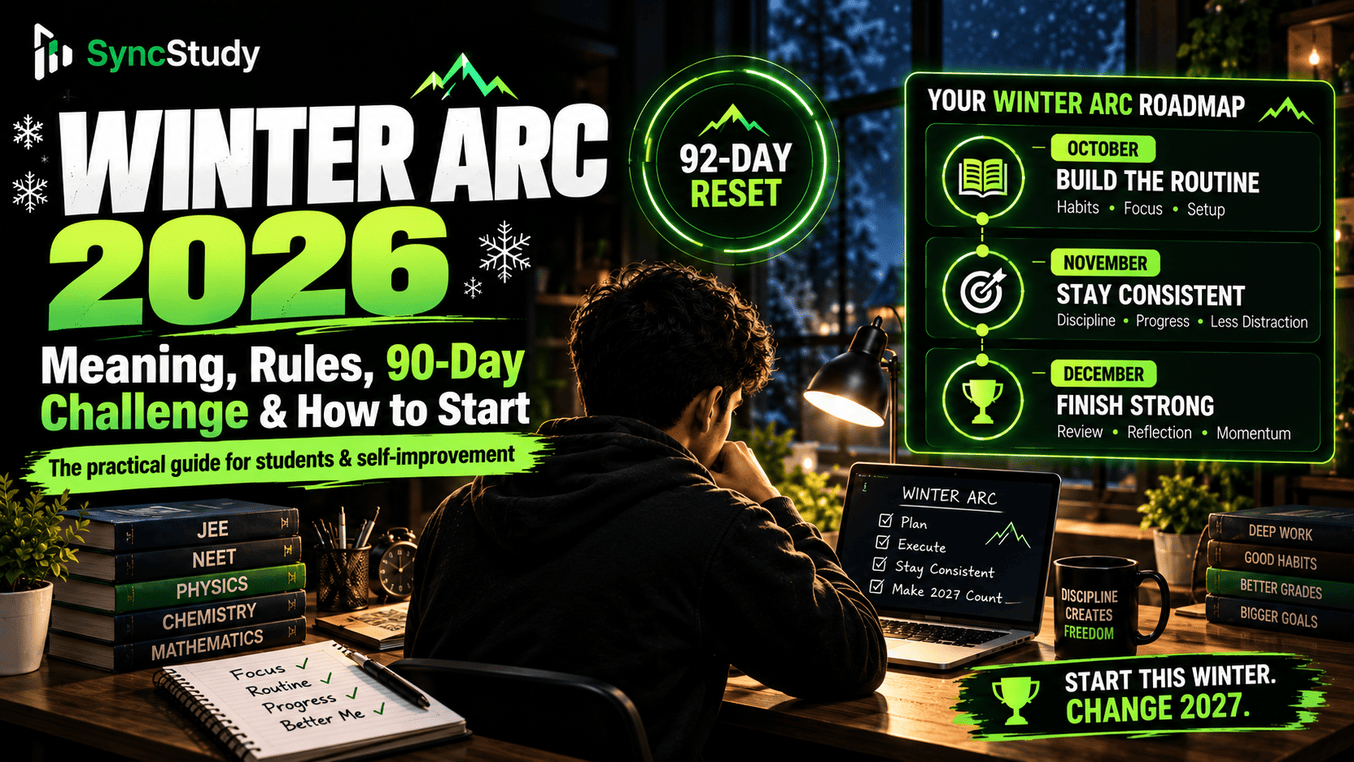
October: Build
Select your 3 to 5 core rules. Organize your playlists, study materials, and environment. Focus entirely on establishing friction-free daily repetition. Do not judge your performance harshly; simply focus on showing up each day.
November: Lock In
The initial novelty of starting a challenge will wear off in November. This is where most people quit. Resist the urge to redesign your routine or switch to new resources. Keep executing the existing system consistently.
December: Finish
Close out remaining targets. Triage weak academic topics or test your skills. Measure your 90-day progress and decide which habits have proven sustainable enough to carry straight into 2027.
Winter Arc for students: how to use it for studying
Whether you are in high school, attending university, or studying for competitive exams like CBSE Boards, SSC, UPSC, GATE, or learning programming from online video courses, the biggest trap students fall into during self-improvement challenges is resource hoarding.
When students decide to "lock in," their immediate instinct is often to download dozens of Telegram PDFs, bookmark twenty new YouTube playlists, join five study Discord servers, and buy new notebooks. But collecting resources is not the same as studying. It creates the illusion of productivity while keeping actual completion at zero.
A high-performance study Winter Arc makes your resources narrower, not broader. Follow this straightforward 6-step study engine:
Choose One Primary Source
Pick one complete YouTube playlist or textbook for each subject. Delete or hide duplicate bookmarks.
Organize and Structure
Map the videos into structured modules or chapters with clear total duration so you know exact requirements.
Schedule Outputs
Assign specific lectures to specific days of the week rather than deciding what to watch spontaneously.
Complete and Take Active Notes
Watch in a distraction-free environment. Write timestamped notes or summary diagrams as you learn.
Revise Weekly
Review earlier chapters every 7 days using active recall rather than just re-watching entire videos.
Test With Real Questions
Solve past-year questions or generate quizzes to verify mastery without looking at solution manuals.
Preparing specifically for JEE Main or NEET?
Check out our comprehensive 90-day Winter Arc study plan for JEE/NEET with day-by-day subject breakdowns and syllabus pacing.
How to organize your study Winter Arc with SyncStudy
If your Winter Arc goal involves finishing online courses or lecture series from YouTube, the hardest part usually isn't finding content. It's keeping that content organized long enough to actually finish it without getting pulled into recommended videos, comment arguments, and sidebar distractions.
This is the exact problem SyncStudy was designed to solve. It converts any educational YouTube playlist into a clean, distraction-free LMS course:
Select one high-quality playlist you genuinely intend to complete from start to finish.
Paste the playlist link into SyncStudy to convert it into a structured course instantly.
See your exact percentage completion and remaining hours without manually logging videos.
Type or format notes right next to the video so you can jump back to key concepts with a click.
Use the built-in study planner to distribute videos across your October–December calendar.
Generate quick self-check quizzes from video transcripts to test your retention actively.
SyncStudy runs right in your browser across laptops, tablets, and phones. The free tier lets you convert up to 3 complete courses with progress tracking and notes. For students managing extensive course libraries and wanting unlimited AI quizzes and summaries, SyncStudy Pro is available for ₹99/month.
Winter Arc habits you can choose from
You do not need to adopt every self-improvement habit simultaneously. Select 3 to 5 options from the table below that align directly with your priorities:
| Area | Example Winter Arc Habit | Simple Way to Measure It |
|---|---|---|
| Study & Academics | One focused 90-minute study block on core subject | Daily completion (Yes / No) |
| Fitness | Gym session, run, or bodyweight workout | 4 to 5 sessions logged weekly |
| Movement | Daily outdoor walk (6,000–8,000 steps) | Phone step counter or days marked |
| Reading | Read 10 to 15 pages of a non-fiction book | Pages read or book completed |
| Sleep | In bed by 11:30 PM, 7.5 hours total sleep | Bedtime followed consistently |
| Digital Wellbeing | Zero short-form video (Reels/Shorts) before 1:00 PM | Screen time report under target cap |
| Skill Practice | Solve 1 coding problem or practice design tool 45m | GitHub commits / project milestones |
| Journaling | 3-line nightly review of wins and tomorrow's plan | Entries written in notebook |
| Nutrition | Eat 3 regular balanced meals; drink adequate water | Days adhered without skipping meals |
Avoid extreme health challenges such as crash diets, excessive caloric deficits, or dangerous water loading. Self-improvement should build physical resilience, not damage your health.
What NOT to do during your Winter Arc
Most failed challenges fail for predictable reasons. Steer clear of these seven common traps:
1. Don't choose 15 rules at once
You are building a sustainable daily routine, not drafting a punishment contract. Three well-chosen rules followed for 90 days create infinitely more progress than fifteen rules abandoned after a week.
2. Don't destroy your sleep to wake up at 5:00 AM
Waking up early is only useful if you went to bed early. Forcing yourself awake at 4:30 AM on 5 hours of sleep leaves you exhausted and unproductive all afternoon.
3. Don't restart from Day 1 after one bad day
Missing a single workout or study session does not erase three weeks of consistent effort. Restarting creates a vicious cycle of perpetual Day 1s.
4. Don't depend on emotional motivation
Motivation is fickle. On cold November mornings, you will rarely "feel" like studying or exercising. Let the predetermined calendar and environment make the decision for you.
5. Don't buy ten complex productivity tools
Spending three days configuring complex database templates is just refined procrastination. Keep your tracking lightweight and straightforward.
6. Don't disappear from everyone you care about
Disciplined focus does not require isolating yourself from family and close friends. Healthy personal connections provide the emotional balance necessary for long-term consistency.
7. Don't turn self-improvement into self-hatred
The purpose of the Winter Arc is to build confidence and capability, not to punish yourself for past procrastination. Focus on steady forward progress.
What if you miss a day?
Here is the absolute rule: do not restart Day 1.
In an authentic 90-day period, life happens. You might catch a cold, face unexpected family obligations, or have an exceptionally demanding college deadline that disrupts your planned workout or study block.
When a miss happens, follow this 3-step response:
- Record the miss honestly: Mark an empty box or a note in your tracker without emotional self-blame.
- Identify the root friction: Did you stay up late scrolling? Did you schedule an unrealistic target? Was your workspace too noisy?
- Execute the next morning: Resume your normal routine the very next day.
Can you start the Winter Arc late?
October 1 provides a clean, shared date on the calendar, but personal self-improvement does not depend on calendar symmetry. A 60-day sprint running from November 1 to December 31 or a 45-day sprint starting mid-November delivers substantial progress.
The principles remain completely identical: choose 3 core rules, set a clear December 31 checkpoint, track your daily completion, and focus on execution.
A Winter Arc checklist you can copy
Copy the template below into your Notes app, Notion page, or a physical notebook:
=== MY WINTER ARC 2026 BLUEPRINT ===
Dates: October 1, 2026 → December 31, 2026 (90 Days)
My Main Milestone Target: _____________________________
// CORE DAILY NON-NEGOTIABLES (3 to 5 Max)
Rule 1 (Focus / Study Output): _________________________
Rule 2 (Physical Movement): _________________________
Rule 3 (Sleep Anchor): _________________________
Rule 4 (Distraction Cap): _________________________
Optional Rule 5 (Skill/Read): _________________________
// FRICTION REMOVAL
My Biggest Distraction: ________________________________
My Solution to Limit It: ______________________________
Weekly Review Day: Every Sunday at 6:00 PM
What Counts as a Win: Hitting at least 3 of my rules daily
My Response to a Missed Day: No restarts; resume next morning
Your first 7 days of Winter Arc
Your objective during Week 1 is not to become a completely new person; it is simply to test and stabilize your system. Here is your Day 1 through Day 7 onboarding plan:
Choose your primary goal and write down your 3 to 5 core rules. Set your calendar tracker.
Clean your desk, bookmark your main study course, set screen-time limits on your phone, and prep workout clothes.
Follow the scheduled routine. Do not try to optimize or judge it yet; just complete the targets.
Notice what part of the routine felt difficult or unrealistic (e.g. studying immediately after college when too tired).
Resist the temptation to rewrite everything. Continue executing today's core checklist.
Complete your study output and physical movement.
Review your week: Which rule worked best? Which rule caused friction? Adjust the environment and set Week 2 targets.
Winter Arc vs New Year's resolutions
How does the Winter Arc differ structurally from conventional New Year's resolutions?
| Dimension | Winter Arc (Oct 1 – Dec 31) | New Year's Resolutions (Jan 1) |
|---|---|---|
| Timing | Starts before the year ends | Starts after the new year begins |
| Timeline | Defined 90-day sprint with Dec 31 deadline | Often vague, open-ended full-year wish |
| Focus | Daily habit execution and systems | Outcome-focused wishes (e.g. "get rich") |
| Q4 Mindset | High focus during seasonal quiet period | Mental check-out and procrastination |
| January State | Enters January already operating at speed | Starting cold from zero |
Does the Winter Arc actually work?
There is nothing mystical about the phrase "Winter Arc." The calendar date of October 1 possesses no supernatural productivity power.
The Winter Arc works only because it applies time-tested behavioral fundamentals:
- Clear parameters: When you know exactly what you are doing, hesitation vanishes.
- Limited scope: 3 to 5 rules prevent cognitive overload.
- Visible feedback: Tracking daily checkmarks provides continuous proof of progress.
- A real countdown: Having an immovable 90-day deadline creates urgency.
The Winter Arc does not work because October is special. It works only if the framework gives you a simple, repeatable routine that you are genuinely willing to show up for every single day.
The real goal of your Winter Arc
The true purpose of the Winter Arc is not to become an unrecognizable person in 90 days. It is not about posting dramatic transformation videos, taking aesthetic desk photos, or working until you collapse.
The real goal is much simpler and far more valuable:
January 1 shouldn't be your starting line. It should be your checkpoint.
When the calendar flips to the new year and millions of people wake up scrambling to figure out how to study consistently, how to get to the gym, or how to reduce their screen time, you will already be three months into the groove. Those habits will already be normal for you.
You don't need fifteen complicated rules. Pick three. Decide what a successful day looks like before you go to sleep. And start today.
Your Winter Arc Starts Today.
Your Winter Arc doesn't need 15 rules. Pick three. Decide what a successful day looks like. Start today. And if one of those goals is finally finishing the YouTube courses you've been saving all year, organize the first one instead of saving another.
Frequently Asked Questions
Related Study & Productivity Guides
90-Day JEE/NEET Winter Arc Plan
Day-by-day execution roadmap and subject timetable for competitive exam aspirants.
Study SystemsStudy from YouTube Like Paid Coaching
5-pillar system to organize free lectures into a structured daily learning batch.
Note TakingYouTube Playlist to Notes
How to turn any long educational playlist into clean, timestamped summary notes.